From earth to object
Every Terra piece passes through six stages — each one unhurried, each one done by hand. This is what happens between a block of raw clay and a finished bowl on your shelf.
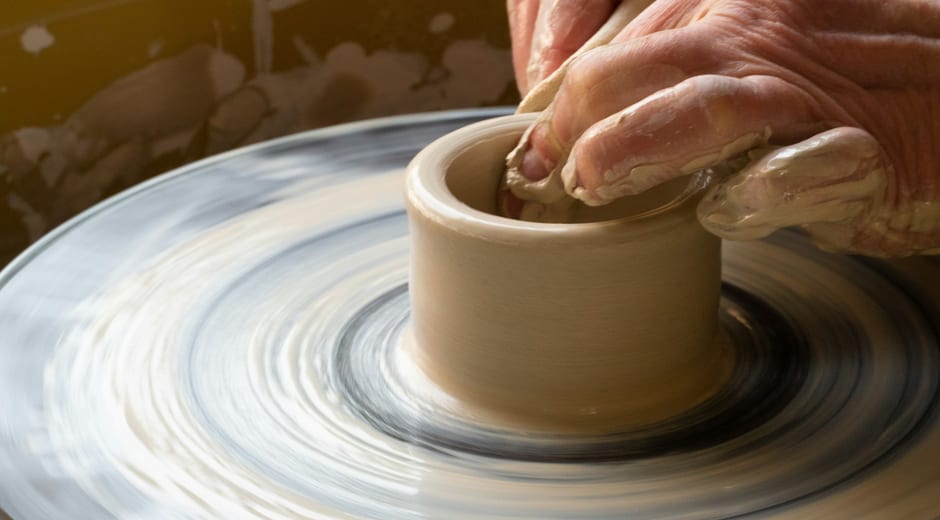
The wheel — where every Terra piece begins.
Sourcing the clay
Every piece begins with stoneware sourced from the Hunter Valley — a dense, iron-rich body that fires to a warm grey-brown and holds glaze with quiet depth. Mara blends it with a small percentage of local porcelain to open the texture and improve plasticity at the wheel.
The clay arrives in 20kg blocks and is wedged by hand before each session. Wedging removes air pockets and aligns the particles — it is the first act of listening to the material.
Throwing on the wheel
Mara throws on a Shimpo RK-Whisper — a quiet, responsive wheel that allows her to feel the clay through the pedal. Most forms are thrown in a single session, though larger vessels may be built in two stages with a drying period between.
The walls are thrown thin. Not so thin they collapse, but thin enough that the finished piece feels lighter than it looks. That tension — between apparent weight and actual weight — is something she has been chasing since the beginning.
"The walls are thrown thin. Not so thin they collapse, but thin enough that the finished piece feels lighter than it looks."
— Mara Jensen, Terra
Trimming and drying
Once leather-hard, each piece is returned to the wheel for trimming. The foot ring is cut, the base refined, and any surface texture added at this stage. Handles are pulled separately and attached with slip.
Drying takes three to five days depending on the season. Byron Bay's humidity means pieces must dry slowly under cloth to prevent cracking. Mara checks each one by hand — a cool spot means moisture is still leaving.
Bisque firing
The first firing — bisque — takes the clay to 1000°C in an electric kiln. This burns off organic matter, drives out chemically bound water, and converts the raw clay into a porous ceramic that will accept glaze.
Bisque firing is the quiet stage. Nothing dramatic happens. The pieces emerge pale and chalky, ready to be glazed.
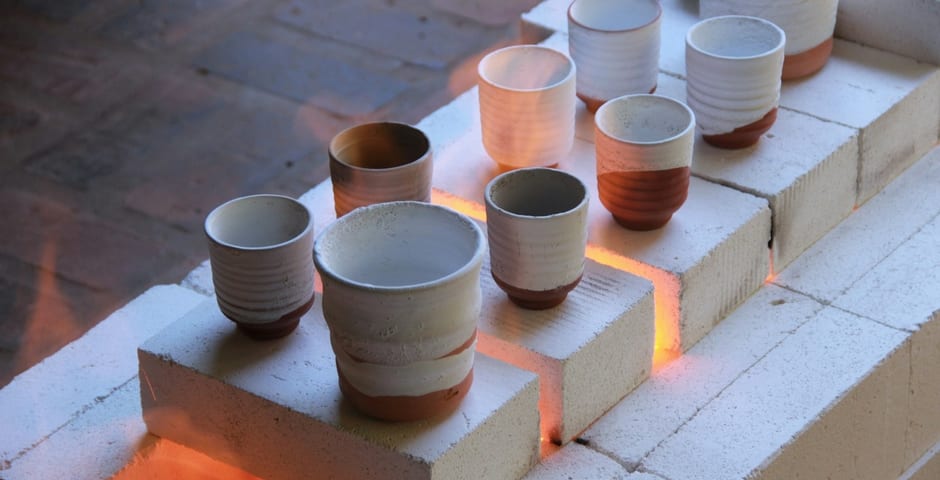
Glazed pieces loaded and ready for the wood-fired anagama kiln.
Glazing
All glazes are mixed in the studio from raw materials — silica, feldspar, whiting, iron oxide, cobalt, and a handful of others. No commercial glazes. Each batch is hand-weighed and tested on small tiles before it goes onto a finished piece.
Application is mostly by dipping and pouring. The interior of a bowl is poured first, then the exterior dipped. Glaze thickness matters enormously — too thin and the surface is dry; too thick and it crawls or runs off the shelf.
Wood firing
The final firing happens in a wood-fired anagama kiln that Mara built over two summers. The kiln is loaded over two days, then fired continuously for 72 hours. Temperature climbs to 1300°C at the firebox and 1260°C at the far end.
Wood firing is collaborative — the kiln has its own character. Ash from the firebox lands on surfaces and melts into natural glaze. Flame paths leave flashes of colour. Carbon from incomplete combustion produces dark markings that no electric kiln can replicate. Each piece carries the record of its own firing.
Hunter Valley stoneware
Blended with local porcelain for plasticity and texture.
Wood-fired anagama
Built by Mara over two summers. Fired twice a year.
1260–1300°C
Cone 10 reduction. 72-hour continuous firing.
All studio-mixed
Hand-weighed from raw materials. No commercial glazes.
The result
The whole process — from wedging to unloading the kiln — takes between six and ten weeks. Most of that time is waiting: for clay to dry, for bisque to cool, for the wood firing to finish. The making itself is a small fraction of the total.
That ratio feels right. The patience is part of the work.